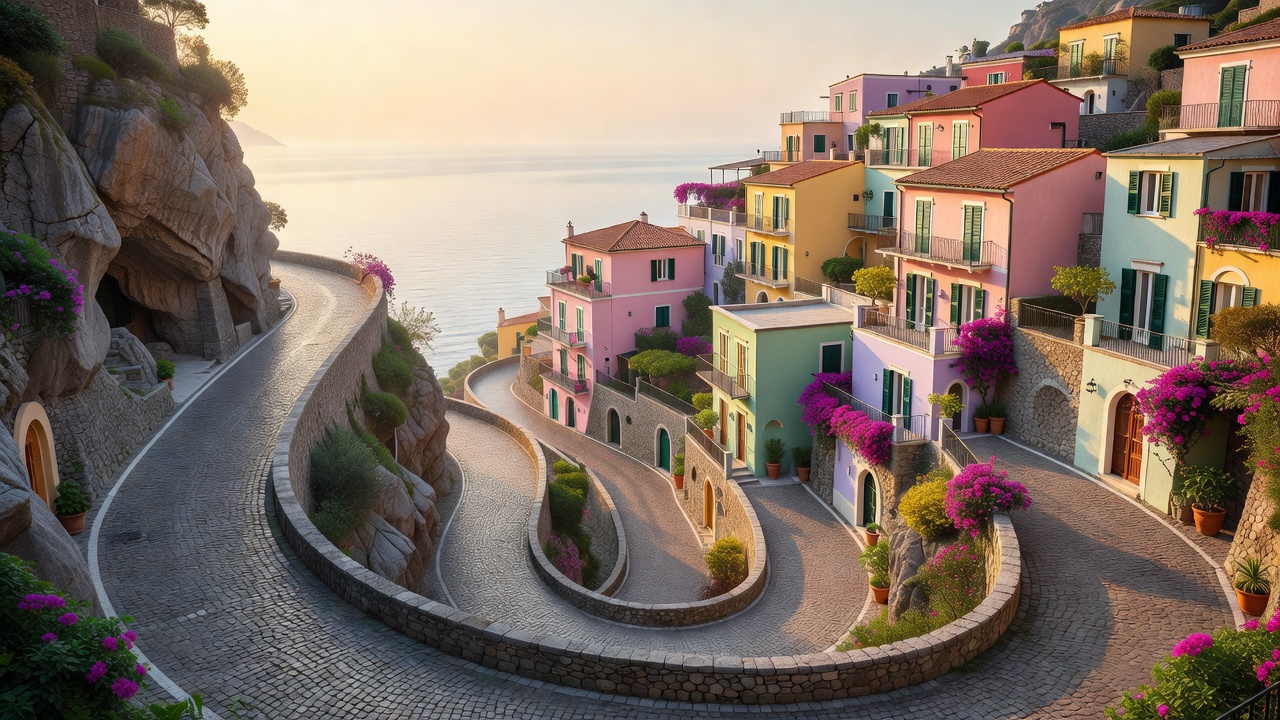
The SS163, famously known as the Amalfi Drive, is a marvel of 19th-century engineering carved directly into the plunging limestone cliffs of Italy's Campania region. While the coastline broadly faces south, the deeply serrated nature of the geography provides countless micro-orientations facing east toward the Gulf of Salerno. However, the primary motivation for driving this route at dawn is not solely geographic—it is logistical survival.
The Necessity of the Dawn Departure
By 9:00 AM during the season, the SS163 devolves into a grueling test of patience. The road is incredibly narrow, often lacking central division, and is heavily trafficked by broad tourist coaches that require reversing maneuvers from opposing traffic to navigate the tight switchbacks. The sensory overload of honking horns, exhaust fumes, and stationary traffic completely negates the romance of the landscape.
Between the hours of 5:00 AM and 7:00 AM, the road belongs almost entirely to the driver. The air is cool and clear, smelling of pine and sea salt rather than diesel. Most importantly, the numerous small pull-outs—impossible to utilize during daytime hours due to volume—are entirely vacant, allowing for spontaneous stops to observe the shifting light.
The Quality of Tyrrhenian Light
The architectural characteristic of the Amalfi Coast towns—Positano, Praiano, Amalfi—is their verticality. Houses in pastel pinks, yellows, and whites are stacked upon each other up the ravines. When the sun crests the eastern horizon over the Lattari Mountains or the sea (depending on your specific location and the season), the light strikes these vertical faces directly.
The visual effect is profound. Because the valleys are deep, the towns emerge from the shadows block by block, turning luminous against the still-dark, indigo backdrop of the sea. The contrast is sharp and clean, without the hazy, washed-out glare that flattens the landscape under the midday sun.
Strategic Morning Positioning
Driving east to west (from Vietri sul Mare toward Positano) offers the advantage of keeping the sea on your left and the cliff on your right, but driving west to east puts the rising sun directly in your forward field of vision.
- Praiano: Geographically, Praiano juts out further south than its neighbors, offering sweeping views both east toward Amalfi and west toward Positano. It is one of the few places on the coast where you can observe both sunrise and sunset unobstructed.
- Ravello: While not on the coastal road itself, driving up the steep connecting roads to Ravello before dawn is highly rewarding. At 365 meters above the Tyrrhenian Sea, the terraced gardens offer a commanding, eagle-eye view over the entire coastline as the sun rises over the Gulf of Salerno.
- The Furore Fjord: A deep, narrow gorge cutting into the cliff. The early morning light struggles to reach the bottom of the fjord, but it brilliantly illuminates the high arched bridge that carries the SS163 over the chasm, creating a striking architectural silhouette.
Driving the Amalfi Coast at dawn requires sacrificing sleep, but it repays the driver with the rare commodity of solitude in an otherwise overwhelmed landscape.