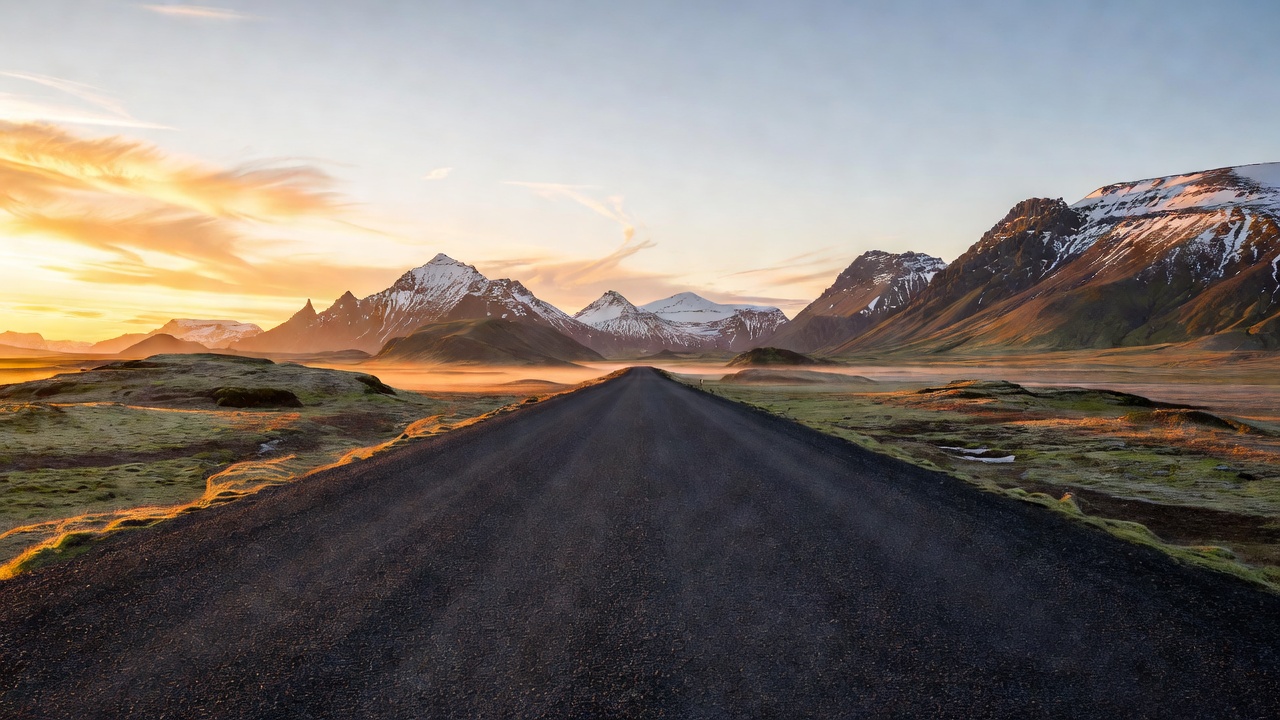
Iceland's Route 1, commonly known as the Ring Road, encircles the island nation, traversing landscapes dominated by glaciers, volcanoes, and deep fjords. The experience of sunrise here is fundamentally altered by the country's proximity to the Arctic Circle. The mechanics of dawn at these latitudes create lighting conditions unlike those found on standard continental drives.
The Geometry of High-Latitude Dawn
In equatorial or temperate zones, the sun rises relatively perpendicular to the horizon, resulting in a brief transition from dark to light. In Iceland, particularly outside the equinoxes, the sun approaches the horizon at a shallow, oblique angle. During the summer months, this results in the 'midnight sun,' where civil twilight blends seamlessly into dawn. During the transitional seasons of spring and autumn, this shallow trajectory means the 'golden hour'—the period of soft, diffused, warm light—can stretch for several hours.
This prolonged dawn is a tactical advantage for the driver. Rather than rushing to a single viewpoint for a three-minute spectacle, one can drive for fifty kilometers, watching the shifting angles of light continuously redefine the texture of the lava fields and ice caps.
Driving Dynamics and Environmental Challenges
The visual rewards of the Icelandic dawn are offset by severe environmental variables that must be managed.
- Surface Conditions: Even in shoulder seasons, overnight temperatures routinely fall below freezing. The pre-dawn drive is highly susceptible to 'black ice,' particularly on bridges and stretches shadowed by adjacent mountains where the tarmac has not yet warmed.
- Wind Shears: Coastal sections and high passes are subject to extreme wind gusts. The lack of trees means there are few visual indicators of impending crosswinds. Maintaining a firm grip on the steering wheel and reducing speed in exposed areas is imperative.
- Blinding Glare: Because the sun remains very low in the sky for an extended period, driving east into the dawn presents a severe glare hazard. The visor often cannot dip low enough to block the intense, horizontal rays. High-quality polarized sunglasses are a strictly necessary piece of driving equipment.
Strategic Dawn Sectors
While the entire route offers potential, specific sectors align geographically to maximize the morning light.
The East Fjords (Austurland): The eastern coastline features deep indentations. Driving sections like the pass over Öxi or the coastal road near Djúpivogur places the rising sun directly over the open ocean, illuminating the dramatic, terraced mountainsides that plunge into the sea.
The South Coast (Vík í Mýrdal): The black sand beaches, such as Reynisfjara, face south but offer wide eastern horizons. The contrast between the stark black basalt columns, the white foam of the Atlantic surf, and the warm hues of the morning sky provides exceptional visual clarity.
Jökulsárlón Glacier Lagoon: Arriving at the lagoon before the amphibious tour boats commence operation allows you to observe the first light striking the floating icebergs. The dense, compressed ice refracts the dawn light, causing the bergs to glow with internal blue and cyan tones against the orange sky.
Pursuing the dawn on the Ring Road requires technical driving caution and an appreciation for slow-moving, elemental shifts in light across a volatile landscape.